How Many People Do You Actually Need? Minimum Headcounts for Pickup Games, Book Clubs, and Group Activities
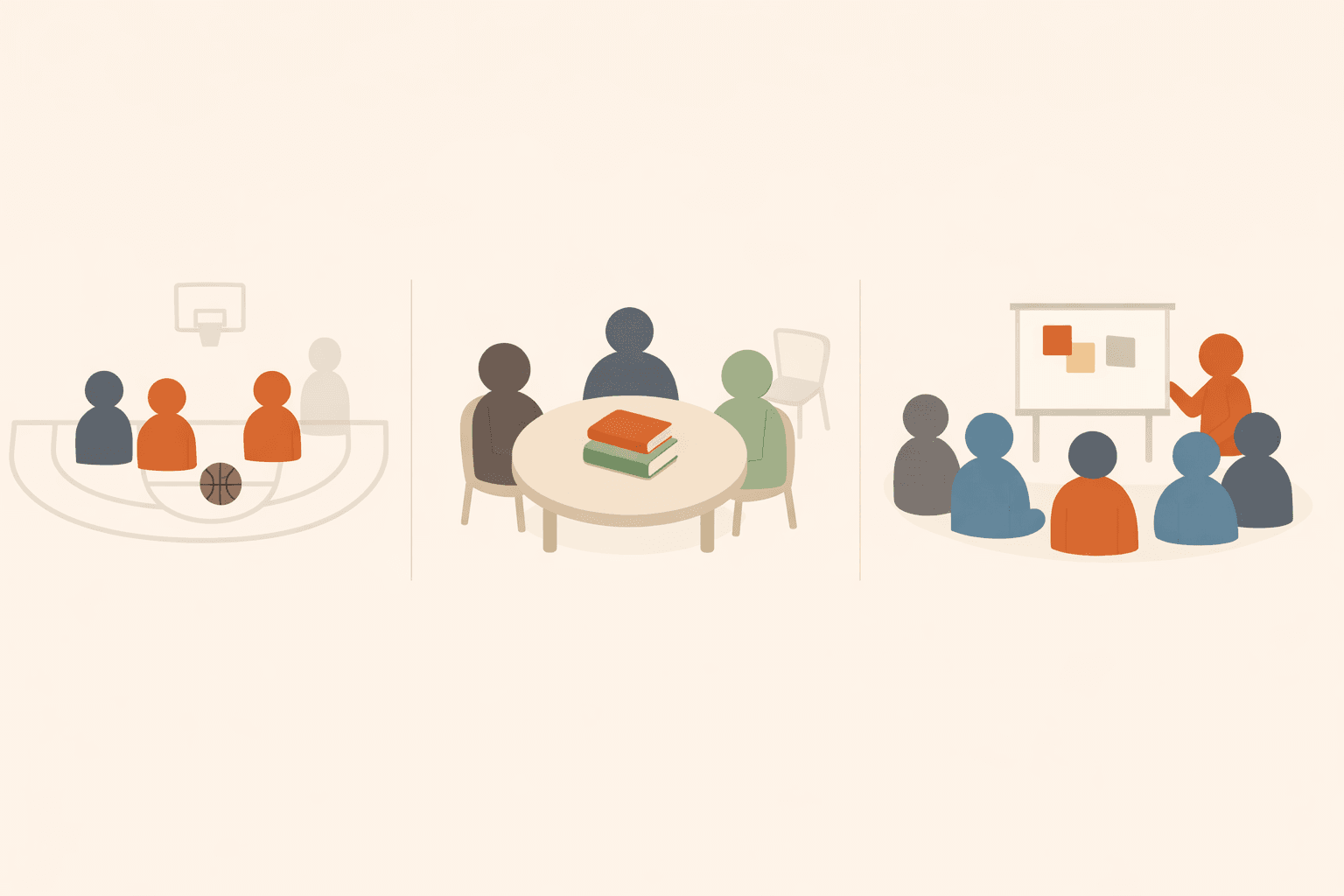
Every group activity has a magic number — the minimum headcount where the event is actually worth doing. Here are the real minimums for pickup basketball, soccer, book clubs, game nights, and more, plus how to stop guessing and automate the whole thing.
Quick take
Pickup basketball thresholds depend on court size and game format: 8 can work well for smaller-court 4v4, while standard full-court 5v5 needs at least 10, and ideally 11 to 12 for subs [1][2]. Most recurring book clubs run best with 4 to 6 confirmed readers. The right number is the lowest attendance where quality remains high.
Try this next
- Set your activity-specific minimum before sending invites.
- Treat unresolved maybes as risk and confirm only from yes responses.
- Run two cycles, then adjust the threshold based on turnout quality.
Key takeaways
- Use activity-specific minimums instead of one global threshold.
- Basketball, book clubs, and game nights each need different attendance baselines.
- Publish minimums before invites so members can make cleaner decisions.
- A visible threshold reduces uncertainty and improves response behavior over time.
Every recurring group activity has a number — the minimum headcount below which the event just isn't worth doing. Five people at a basketball court isn't a game. Two people at book club isn't a discussion. Three people at a dinner party is an awkward meal.
The problem is that most groups never define this number explicitly. The organizer carries it around in their head, manually counts RSVPs, and makes a subjective call every time. That's how groups slowly die: not from lack of interest, but from the uncertainty of "are enough people actually coming?"
Here's a practical breakdown of minimum headcounts for common group activities — and how to stop guessing entirely, with official baselines like FIBA's basketball rules and IFAB's Law 3 on player counts as reference points.
How Many People Do You Need for Pickup Basketball?
The answer depends on the format you want:
- 3v3 half-court — Minimum 6 players. Fast-paced, works on a single basket, and the most forgiving format when attendance is unpredictable.
- 4v4 full-court — Minimum 8 players. Feels like a real game without needing a full roster. This is the sweet spot for most pickup groups.
- 5v5 full-court — Minimum 10 players. The classic experience, but harder to consistently fill. Having 11–12 is ideal so you have subs and can rotate.
Recommended minimum depends on your court and format: use 8 when your default plan is smaller-court 4v4, and use at least 10 for standard full-court 5v5. If possible, target 11-12 on full court so you have subs for fatigue, minor injuries, and last-second dropouts.
If you're organizing a weekly pickup game, the biggest threat isn't people saying no — it's people saying nothing. When members don't know if the game is happening, they make other plans. Setting a visible quorum threshold solves this: everyone can see the count, and once you hit your format-specific minimum (for example 8 for smaller-court 4v4 or 10 for full-court 5v5), the game is confirmed automatically.
Ready to apply this in your next cycle?
Use the same flow in one live event and compare your confirmation speed.
Minimum Players for Pickup Soccer
Pickup soccer is more flexible than basketball because small-sided formats are genuinely fun:
- 4v4 or 5v5 small-sided — Minimum 8–10 players. High-energy, constant involvement, works on any field or open space.
- 7v7 on a reduced pitch — Minimum 14 players. Feels tactical without needing a full 11-a-side roster.
- Full 11v11 — Minimum 18 players (realistically 22). Hard to organize casually and best left to organized leagues.
Recommended minimum: 10. That gives you 5v5, the most common format for casual pickup. If a couple of people flake, 4v4 still works.
How Many People for a Book Club?
Book clubs have a different dynamic — too few people and the conversation stalls, too many and quieter members never speak.
- Minimum viable discussion — 4 people. Enough for genuine back-and-forth without one voice dominating.
- Ideal range — 5 to 8 people. Rich enough for diverse perspectives, small enough that everyone participates.
- Upper limit — Above 10–12, discussions fragment. You end up with side conversations and people who attend but never talk.
Recommended minimum: 4. Below that, members start assuming "it probably won't happen this month" and skip — creating a self-fulfilling prophecy. When the group can see that 4 people have confirmed, the maybe-ers commit.
Minimum People for Board Game Night
Game nights depend heavily on which games you play, but the logistics are consistent:
- Party games (Codenames, Werewolf, Wavelength) — Minimum 6. These games need volume to work. Below 6, the energy drops.
- Strategy games (Catan, Wingspan, Ticket to Ride) — Minimum 3–4. Most modern board games are designed for 3–5 players.
- Large-format or multiple-table nights — Minimum 8. Enough to split into two groups and play different games simultaneously.
Recommended minimum: 6. That gives you flexibility to split into groups or play party games, and it's high enough that one no-show doesn't kill the evening.
Minimums for Running Groups, Study Sessions, and More
- Running or cycling groups
Minimum 3–4. Group runs work at any size, but below 3 it stops feeling like a group and accountability drops. Set your threshold at 4 for motivation and safety.
- Study groups
Minimum 3–4. Enough to quiz each other and fill knowledge gaps. Above 6, focus starts to wander. A threshold of 4 keeps sessions productive.
- Dinner parties or potlucks
Minimum 6. Below that, the host over-cooks and the table feels empty. Knowing 6 people are confirmed before you start prepping food is a genuine quality-of-life improvement.
- Poker or card nights
Minimum 5 for Texas Hold'em, 4 for most other formats. Poker specifically falls apart below 5 because the blinds cycle too fast and there aren't enough players for interesting hands.
- Volleyball (outdoor/beach)
Minimum 8 for 4v4, 12 for 6v6. Beach doubles need just 4 people but that's a different activity entirely. Set the threshold based on which format your group prefers.
Why You Should Set the Minimum Before the Event, Not After
Most organizers make the cancel/go decision after RSVPs come in. That sounds reasonable but it creates a toxic pattern:
- Organizer sends a "who's in?" message.
- Some people respond immediately, some wait, some forget.
- The organizer privately calculates whether it's "enough."
- Members who haven't responded see the uncertain energy and hold off.
- The event either happens with low energy or gets cancelled last-minute.
Setting the minimum upfront changes the dynamic entirely. Members see a clear target. They know their RSVP moves the count toward a threshold. And when the threshold is hit, there's no ambiguity — the event is happening. No one has to text the organizer to ask "is this still on?"
How to Automate the Headcount (So You Stop Being the Counter)
If you're the person who organizes a recurring group activity, you already know the worst part: manually tracking RSVPs. Scrolling through messages, counting "I'm in" replies, deciphering whether a thumbs-up emoji is a real commitment.
Quarmup is built specifically around the quorum threshold model. You create a group, set the minimum number, and schedule events. Members RSVP directly from email with one tap — no accounts, no app download, no friction. When the threshold is hit, everyone gets notified: the event is ON.
No more counting. No more judgment calls. No more "is this happening?" texts. The system answers the question for you.
Try the interactive demo to see it in action — pick a scenario like pickup basketball or book club, set your own threshold, and watch the quorum flip the event to ON. No sign-up required.